Saturday, 14 December 2024

Thoughts on 'The History Boys'


I watched 'The History Boys' for the first time last night. I asked myself, why is this the first time? It's because when it came out, first as a play and then as the film, all the write-ups made it sound so close to my own schooling that I think I was almost afraid to go and see it. And I was right! There were so many overlaps and coincidences that I was wincing - all exacerbated when I realised (nearly 10 years later than anyone who went to my school!) that many of the scenes were shot at my old school. This made it feel even more as if I was in the scenes. I realise that this is absurdly egotistical, but then I thought again: maybe it's much better to think of it as a play/film that captured something (but what?) of that tiny, tiny layer in society that I belonged/belong to. (For my last two years at school, I went to Watford Boys Grammar and then I went to Oxford University (via doing a year at Middlesex Hospital Medical School. ).

This then led me to wonder about why or how this tiny fraction got to be amplified and sanctified by this play and film. And from there I got to thinking about how (or why not) the film dealt with the matter of class. In one sense, the whole film is about class though a lot of it seems to be about how England creates an 'intellectual' along with a particular view about sex (in that environment).

I've always been of the view that society creates education rather than education creates society, though as Marx puts it (or something like it) 'Even the educator is educated'. In other words though society creates education, there is a way in which the education that society creates, does its bit of creating of society in return. Within the scope of this play/film it was hard to see how the big motor of society creating education (this specific form of education) ever appeared. The one moment when it could have done, perhaps, was at the end when we hear (in a flash-forward form) what happened to the boys in later life. In fact most of them are shown to have ended up in middle class jobs - not even what we might call upper-middle class jobs.

So here's the class bit. These old grammar schools and foundation schools do succeed in getting students into Oxbridge in what used to be a largely private ('Public') school enclave. Why? What function does it all serve? Why does this society like this, and encourage it? Presumably because there is some kind of consensus that this is a good way to create a 'cadre' of 'top' scientists, administrators, lawyers, judges, and CEOs. ``But more than that, this 'cadre' has learned how to reproduce itself (see Pierre Bourdieu). In other words, the 'cadre' (in this case 'grammar school boys') keeps the institutions and the channels open. Sons follow in fathers' footsteps.

So then we come to the matter of what appears to be the substance of the film (I'm not sure it is, and if it is, I'm not sure it actually dealt with it!) 'what is history?' and 'how do we teach it?'. Imagine for a moment if the action of the film was taking place during a major war, then 'history' would have been coming in through the windows. The issue of recruitment and training an officer class for that war, would have been central to everything. The boys would have been divided between jingoists, accepters and rejecters. 'History' wouldn't have been something abstract or even cynically reduced by the Rudge character to 'one thing after another' (or some such).

Perhaps I missed it, but we didn't get a sense of the boys reflecting on how they were being 'made' for a particular niche or place in society. As it happens, my year and the year above me at Watford did reflect on those things, did try to work out how the actual nature of the knowledge and the teaching methods and exam systems they were giving us, was a preparation for roles in society they thought we should or would take up. We even figured out that things like the Prefect system were part of how they were trying to train us for this cadre and some of us (well me) refused to become a Prefect.

The sexuality issue was interesting in that though the story is set in 1980s, it was certainly a live issue in the early 60s when I was in the sixth form. It was an issue in different ways, in that we were openly homophobic. In fact, there was a way in which we policed ourselves to be homophobic. Meanwhile, there was one teacher who was understood to be what we would now call a 'molester'. So there's a contradiction there: we were intolerant of homosexuality but the authorities were tolerant of someone molesting students.

Finally, the Jewish boy. I'm afraid I may have dozed off at one point where the plotline that involved him came into play but this too was very near to home. As far as I ever understood at the time, I was the only Jewish boy in the Watford Sixth Form at that particular time (1962-64). It's possible there were one or two others who had learned how to keep out of sight so they could avoid having it being used as part of low-level jibing and mocking. So I arrived into a school, that didn't seem to 'know' Jewish students. I came with my own version of Jewishness (historically aware, coming out of the radical, Communist, and 'Bundist' (Jewish Socialist) traditions) a nuance that the jibers and mockers didn't 'see'. Within weeks of my being at the school, I was on the receiving end of jokes that I had never heard before. Two of my year group would throw money on the floor and say, 'O you better not do that, he'll pick it up and you won't get it back.' (there were variations on this.) At that moment, I didn't even really know the trope (in face to face terms in London 1962) that Jews and cash in your pocket was a thing. I didn't know that there were jokes that someone who wasn't Jewish could say against someone who was Jewish, along those lines.

As it happens, because I didn't rise to the bait (mostly because I didn't 'get' it), this stuff dissipated after a few weeks, and never came back. It was more of an opening salvo in the male jostling for the upper-hand than a consistent piece of insulting or persecution. Far from it. And, confession: I was as much part of that male jostling if not more so, as anyone else. I'm not some innocent party in this. The play/film captured some of that quite well. If anything though it could be more brutal than it showed and someone who is one moment on the receiving end, can easily be the person dishing it out later. There's some kind of mutual corruption goes on there. This too is part of 'education' of course.

Well, if a play/film gets you thinking, The History Boys certainly did that. As you can see, it got under my skin in uncanny ways.

Final comment added later:

Of course another way the play/film doesn't notice 'history' is in that even as they're talking about history, we don't see the history being enacted through there being no sight of all the other boys/girls going to schools or apprenticeships or work at that precise moment at the same time! What are all the other 18 year olds doing? One thing we learned through doing the 11-plus and going to grammar school (or could have learned if we didn't resist it) was to fear and despise those who went to Secondary Modern Schools, and envy those who went to private schools ('Public Schools). This was subtle, persistent, never-ending, often played out within families as well as between them, (one child going to the 'grammar', one to the 'sec mod', and even one going private and the others not. But socially and society-wide, the filtering, selecting, and segregating was (and is) going on throughout our schooling. As do the expectations, the style of education and indeed the content. 

Though it's rarely admitted, the strange, inconsistent and historically odd way in which education is delivered to the whole cohort year by year produces what is in effect the horses for courses of a class society. However you describe the hierarchies or systems of control or systems of exploitation and class, you can find ways in which mostly (not entirely or always consistently) the school system has ended up matching it and helping to reproduce it. You can map on to society the different kinds of secondary schools, showing how more or less they do the job of making sure the round pegs go into the round holes and the square pegs go into the square holes.

Saturday, 16 November 2024

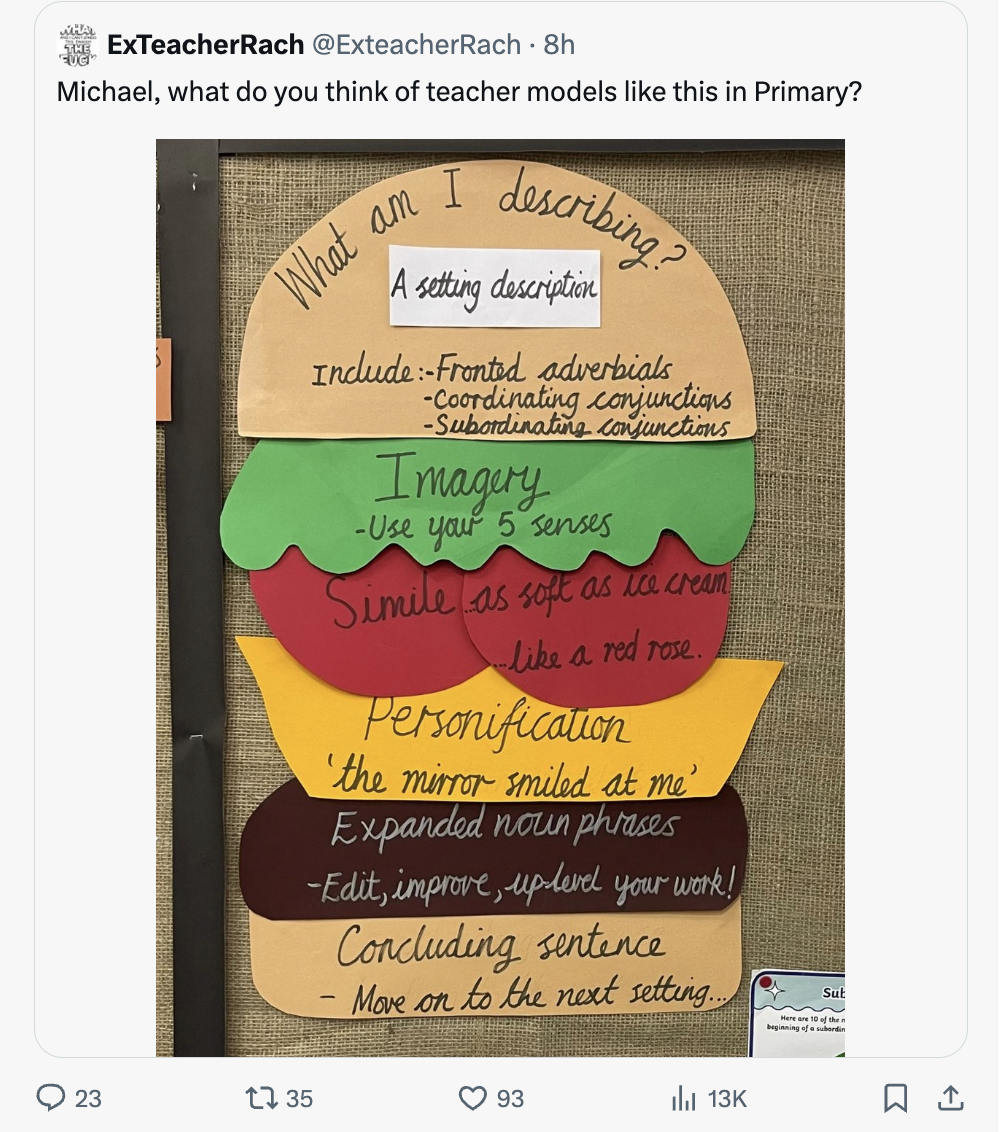
I was asked to comment on a 'teacher model' for writing in a primary school. I did.


This is a tweet I received.

I replied like this:

1. It's a nonsense. It's no help for children to write interesting stories or non-fiction. It is overly, misleadingly and mistakenly focussed on sentences and not on themes, or characters' dilemmas/motives. And fails to talk of 'story' grammar eg reveal-conceal, story arcs, obstacles.

2. If you want to help children improve their stories, you have to deal with motive, which then leads to how do we know motives, often through flashback and 'interiority'. Again: nothing here on narration. Ominiscient or first person? Omniscient with p.o.v. of one character or more?

3.Another point: most modern fiction is about enabling the reader or taking the reader 'there', to the mindset or place or time of the story. How do you do that? Through the eyes of the protagonist or through narration or both? Help children to do that!

4.In sum, the advice coming from government about story, is ignorant and irrelevant. That's because they won't (and never do) talk to writers about writing. It's absurd.

5. When it comes to sentences, the advice we got in the 1950s is more helpful. Sentences are made up of phrases (groups of words with no verbs) and clauses (groups of words with verbs). That simple advice, helps you construct sentences.

6. As for 'fronted adverbials' and 'expanded noun phrases',. they are neither good or bad. They can be either. Telling children they are good is a nonsense. What matters is choosing when to use them and not use them. Same with similes (which are nothing to do with grammar).

7. I'm glad there's advice about the senses but this misses out other motors for writing: namely memory, imagination and knowledge of images, scenes and motifs from other 'texts' (stories, songs, films etc) that you can adopt, adapt and recycle in your 'text'.

Thursday, 7 November 2024

How and why the Primary English 'Writing' curriculum has got it wrong


1/ Because the Primary English curriculum for writing has got distorted to focus on 'grammar', we overlook that writing can be developed by looking at 'ingredients': who narrates? can we deepen characters with flashbacks? can we create expectation/tension with 'reveal-conceal'? 
2/What is a 'story arc' of a character through a story? How do we create motive, develop motive, satisfy or 'punish' motive by the end of the story? Do all the 'cogs' of the story engage throughout? Who helps, who hinders the protagonist(s)?
3/ Are we clear at the beginning what is the 'problem'? Is it a dilemma? A lack of something? A yearning for something? How will the character(s) achieve or attain the objective? Will they do it through their own actions? How do they engage with others?
4/ Are you in the story? ie how can you use your own experience? How can you adapt it, twist it, play with it, in order to provide detail, motive, imagery, feeling? How do you bring a reader nearer to 'a moment' in a story? (ie using sensory detail - using any of the 5 senses)
5/ How do you create 'interiority' ie people's thoughts and feelings? Do you do it with 'direct tags' eg 'she thought...' indirect, 'she thought that...' or 'free indirect' ie no tag and eg 'what should I do next?' or even 'what should she do next?' as if in my mind of 'she'.
6/ The present curriculum has pulled writing away from these fundamentals and focussed on the sentence, and bogus ideas of how sentences are constructed ie 'grammar' of words, and very little (or misleading stuff) on phrases and clauses.
7/ I suspect that the reason why nearly all of the previous are overlooked or passed over briefly is because the people in charge of primary Writing, have never read or understood anything about 'narratology' or practical writing guides for eg film students etc.
8/ The whole primary English curriculum is dominated by a 1920s view of language, uninformed by descriptive linguistics, stylistics, narratology and intertextuality. It's as if Physics ignored Atomic Physics. How do they get away with this mix of ignorance and prescriptiveness?
9/ The authorities rely on the fact that primary teacher training doesn't expose teachers to modern linguistics/stylistics/narratology while they (the authorities) are wedded to atomised, prescriptive, measurable units in relation to story and narrative.
10/ Further, the authorities can rely on the ignorance of MPs and ministers, who will themselves rely on people speaking with seeming authority about 'writing standards' by which they mean the measurable atomised parts of writing at the sentence level.

Tuesday, 5 November 2024

Bear Hunt and how it became a legal matter

I posted a blog here and linked to it on X (formerly Twitter), the blog 'The True Story of the making of the book of 'We're Going on a Bear Hunt' ('Bear Hunt')'.

Since then, people have raised questions about me being sued for libel in relation to Bear Hunt. Some people have claimed that: 

a) I didn't write Bear Hunt and therefore 

b) I had no right to complain that it had something superimposed on it in a tweet in May 2021, and that, 

c) I had no right to complain that the words in the tweet were anything to do with me.

What follows is what the people (the 'Claimant' and the 'Claimant's solicitor') who sued me for libel wrote about this. You'll see that it's precisely the opposite of these points (a), b) and c) above when they sued me. As follows: 

(I'm the 'Defendant'.) 

1.

"The words Protocols of the Learned Elders of Zion were superimposed on the book being held by Mr Corbyn. The book is a children’s book written by the Defendant, We’re Going on a Bear Hunt.'

2.

"The caption in the Claimant’s Tweet is a corruption of words taken from We’re going on a bear hunt."

(These two points are taken from the Particulars of Claim - ie the document sent to a Defendant (in this case me) if you're suing someone for libel.)


---------

If there's any doubt about what this means, then something similar was written by the Claimant when writing to his university: 

1.

"The words accompanying the image were a pastiche and parody of Michael Rosen’s book “We’re Going on a Bearhunt”."

2.

"In so doing, I echoed the use Mr Rosen has himself made of those words for political purposes."

(These two come from a Subject Access Request.) 


------

To draw this together, I'll make the point that as the Claimant accepted that the words in 'We're Going on a Bear Hunt' are by me, and that the words on the tweet were a 'corruption' a 'parody' and a 'pastiche' of Bear Hunt and that these words 'echoed' what I had done with the words from Bear Hunt, there really is no point in people writing statements on 'X' or anywhere else to the effect that I didn't write Bear Hunt, or that the words in the tweet were nothing to do with me. In effect, it's not me contradicting such statements, it's the statements from the Claimant that I've quoted above that contradict such statements.  


Writing workshop - the 'how' of writing


Yesterday, I met up with several hundred teachers in Colchester to talk about writing.

I talked about how I had turned an episode from real life into a story for my book 'Barking for Bagels'. This meant thinking about 'who tells the story?' (ie who 'narrates'? Omniscient narrator? First person? Child? Or the dog?!

Then thinking of story as beginning with problem/dilemma/lack of something, and how to resolve it through 'helpers' and facing challenges/obstacles;

thinking of characters' motives and their 'story arcs' through a story.

If you want to give a character depth then you have the power of the flashback or 'back story'.

I talked of 'reveal-conceal' as the motor for making you want to know what comes next. (We experimented with different images or motifs for how to generate 'reveal-conceal' - one teacher came up with receiving a parcel with the right address but the wrong name on the address...)

Then I talked of prequels, sequels and spin-offs (eg movie of 'Where the Wild Things Are' which justifies or reveals why Max is angry, and last page of 'Bear Hunt' where children 'fill in' what the bear is thinking.)

How you can play with characters, settings and time-frames to alter stories that already exist. I talked of my book 'Macbeth United' which is an update of 'Macbeth' transposed into a children's football team!

And there was time to talk about the easiest way to start poems is to read a poem and say to oneself, 'I could write a poem like that' as triggered by the poem's shape, rhythm, rhyme scheme, an image or images, feelings, or indeed anything that comes to mind.

Saturday, 21 September 2024

The reason why Year 6 children in England 'do grammar' is nothing to do with 'grammar'! It's entirely to do with the government deciding it had to assess teachers.

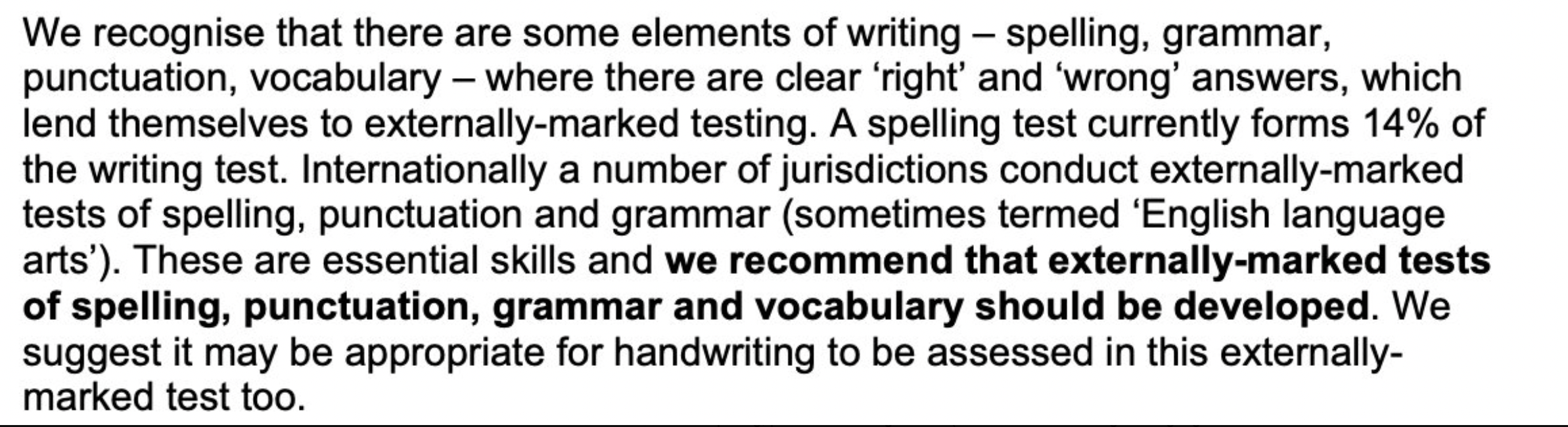
The piece of official writing that I'm referring to in this post, is at the bottom of the post. It comes from the Bew Report (2011) and is available online. I haven't made it up!
The people who decided that children in Year 6 in schools in England would 'do' grammar, did not decide to do so for reasons to do with 'grammar' nor to do with children. It was not a decision made because teachers, or advisers, or researchers sat in a room and thought it would be a good idea to do grammar for reasons to do with language, writing, linguistics, children's development. The reasons were entirely to do with a government trying to work out how to assess teachers and teaching. They wanted a tool to do it with.
If you think I'm being too political or too conspiracy-theorist about this, then please let me draw your attention to one part of one paragraph in the Bew Report of 2011 (see below). It's available on the gov.uk website. In this piece of the report you can see clearly that this huge change in the Year 6 curriculum was made purely and only in order to assess teachers - yes - but in itself, it was based on a total fallacy: that 'grammar' has right and wrong answers.
Digression: there are various ways of describing language (ie how we speak, write - and to a certain extent - think.) There are several, if not many, grammars. There is also the fact that we do grammar without anyone describing it anyway, just as the landscape does landscape without geographers describing it.
Some grammars are flexible, tentative, open to possibilities and which accept that human language is part of human behaviour and so frequently defies being tied down to simple categories.
So the 'grammar' that the government chose to implement is one specific form of grammar. It is rigid. Some of it is based on out-dated terminology. Some of it isn't even grammar (eg 'synonyms). Some of it is disputed (which in itself is no bad thing, precisely because some language production (ie how we use language) can't be tied down. )
As I've mentioned before, one example of all this is 'tense'. As a word, it is used to refer to the idea that a specific 'verb form' like 'I am going' is attached to and expresses a particular time frame. In this case, the 'present'. You know that, without me telling you that! You say every day things like 'I'm going to the shops' and so 'am going' helps you say that you're doing something now. So grammarians (who noticed that Latin does the same sort of thing) called it the present tense (though in this particular example they distinguished between 'I go' and 'I am going' and called the first the 'present tense' and the second 'present continuous'. People who have to teach Year 6's now, will notice that they have to call it the 'present progressive'. That's because grammarians form into terminology camps. Spend a few minutes online and you can find that terms used for parts of speech vary all over the English-speaking world. So the claim that 'grammar' produces right and wrong answers is false even on those grounds alone. The universal ways or terms for describing language have long lost their universality, or were never there in the first place. Spend some time looking at how to describe 'my' in 'my Mum', for example!
Back with 'tense': you'll know that you can say and probably do say, 'I'm going out tomorrow'. 'Present progressive', surely. But 'tomorrow' indicates that this about the 'future'. In other words, the sentence as a whole indicates 'future'. And yet it uses a present tense. How come? Because grammar doesn't have right and wrong answers. And because the terminology needs to be more flexible. Perhaps it would be more useful to ask, 'how do we express time through language? Sometimes we can do it through verb forms. Sometimes we do it through combinations of words as with this example - using 'tomorrow'. In other words, we need a description that is fit for purpose and not a rigid one that doesn't allow for what we really say, write and think.
People who've had to 'do' this grammar and the absurd test in May of Year 6 also notice that there are questions in the exam that express certainties about language which aren't there. In the first year that they implemented the exam, there was a question to do with putting an 'adverb' (a term that is long past its usefulness anyway) in the clause 'The sun shone [....]' There was a choice of words, I think. The 'right' answer was 'brightly'. The wrong answer was 'bright'. Just say to yourself, these two alternatives. You may remember the song about the moon shining bright on Charlie Chaplin. Anyway, the linguist David Crystal wrote to the examiners and told them that 'bright' was a valid answer. Of course, they ignored him.
Yesterday, I posted here, a discovery I made that on the government's own website where it is trying to say, in effect, 'this is how you write well, using the grammar that we tell you to teach', they can't get it 'right' according to their own rules.
So, the apparatus is at fault. It's been brought in on the premise (the sole premise) of assessing teachers. It's not been brought in because it's valid in itself. Here's the part of the para from the Bew Report (2011). Please distribute it as widely as you can. There is a new government in power. It might just be faintly possible that someone 'up there' will listen to this argument.


Thursday, 19 September 2024

The Meteorite Gove hit schools and left this kind of chaos (and wrong advice) for children on how to write.

 As teachers know, a crazed and obsessive meteorite-like thing hit schools in around 2010 and schools have never been the same since. It was called Gove. One thing that Gove did was switch the idea of writing from being something that is 'about' something, to being 'how you write'. However, the 'how you write' was a paraphernalia of old-style grammar, much of it altered and refined by people over the years, though these alterations and refinements are mostly ignored by this SATs 'grammar'. There are also parts of the 'grammar' curriculum that aren't anyone's definition of 'grammar' eg the requirement to answer questions about 'synonyms' (which serious linguists think don't exist, anyway!). This is all part of the Gove that hit Year 6 children in schools in England.

One result of this was the government put up examples of 'good writing' that children had done, on their Gove.uk website. (Sorry, gov.uk website). These are analysed (in terms of this old grammar) so that teachers can tell their pupils what to include in their writing. As I said, it's about 'how' to write, not about 'what to write'. The examples below come from 'Teacher assessment exemplification: end of key stage 2'
One problem, the people who've done the analysis of these examples (presumably not Gove as the Gove landed and then disappeared according to that old government principle of Dump and Run - see David Cameron for another example) is that they get the terms wrong! They've labelled the bits of sentences (that they think help children write, and got the terms (as according to them) wrong. I'm not bothered but I just happen to know the terms because I was taught them back in the Stone Age when I was at school and have also kept up with what they teach Year 6 children now.
So here we go: take a look at this (below). However, please don't 'correct' the spelling in the writing they're analysing. That's from the child's own writing.

In short, what they call a 'subordinate clause' is not, according to their own terminology, a 'subordinate clause'. What it is, can be much disputed of course! Some call these things an 'adjectival phrase', or an 'adverbial phrase' or a 'participial phrase' depending on which side of the moon, you can see, on that particular night.

What's really sad about this is that for all the footnotes and comments littered all over the page analysing Morgan's piece of writing, there isn't a single comment that says whether the writing is exciting, or intriguing, or interesting or full of tension or some such. In other words, a child gets the message that writing isn't about writing something that we care about emotionally, culturally or socially in any way. It's about 'getting it right' according to a scheme of 'rightness' that the people forcing this stuff on to us, can't even get 'right' themselves. [If you find these too small to read, just click on them!]